

Table of Contents
Wipro Share Price Target 2026, 2027, 2030
Wipro Ltd. (NSE: WIPRO, BSE: 507685) is one of India’s large IT-services companies, with exposure to consulting, technology services, engineering, business-process services and AI-led transformation. As of September 30, 2026, Wipro’s share price was around ₹159.24. The stock has been under pressure during 2026, trading well below its previous 52-week high.
MCX Gold Price Today | Gold Rate Today
Exide Share Price Target 2026, 2027, 2030
Tata Motors Share Price Target 2026, 2027, 2030
The Wipro share price target 2026, 2027, 2030 presented below is a scenario-based valuation exercise. It combines earnings assumptions with reasonable P/E multiples rather than assuming that the current share price will simply compound at a fixed rate.
Important data cut-off: Wipro’s Q2 FY27 results have not yet been reported as of September 30, 2026. The company has scheduled its Q2 FY27 results for October 15, 2026. Therefore, this analysis uses FY26 results and the latest reported Q1 FY27 results, supplemented by available analyst estimates and scenario assumptions.
Block Deals NSE Today | Bulk Deal NSE
Wipro at a Glance
| Metric | Latest Available |
|---|---|
| Company | Wipro Ltd. |
| NSE Ticker | WIPRO |
| BSE Code | 507685 |
| Share Price | ₹159.24 |
| Analysis Date | September 30, 2026 |
| FY26 Revenue | ₹92,620 crore |
| FY26 Net Income | ₹13,200 crore |
| FY26 EPS | ₹12.60 |
| Q1 FY27 EPS | ₹3.20 |
| FY26 IT Services Operating Margin | 17.2% |
| FY26 Operating Cash Flow | ₹14,931 crore |
| FY26 Free Cash Flow | ~₹13,371 crore |
| FY26 ROE | ~15.4% |
| FY26 ROCE | ~14.7% |
| Current P/E | ~12.1× |
| Current P/B | ~2.1× |
FY26 revenue increased 4.0% while net income increased only 0.5%. IT-services revenue declined 1.6% in constant currency, although large-deal bookings increased 45.4% to $7.8 billion. Operating cash flow remained strong at 112.6% of net income.
Business & Growth Outlook for Wipro
Wipro operates primarily as a global technology-services and consulting company. Its business spans consulting, technology services, engineering and business-process services, with strategic market units covering the Americas, Europe and APMEA.
Major Growth Drivers
1. Artificial intelligence
AI is becoming a central part of Wipro’s strategy. In April 2026, Wipro created a dedicated AI-Native Business & Platforms Unit to build and scale AI-led platforms, enterprise-grade agentic AI solutions and new AI-native businesses.
The company is also developing platforms such as WINGS and WEGA and has expanded its AI ecosystem through partnerships and its Applied AI Center of Excellence for Anthropic’s Claude models.
2. Large-deal pipeline
FY26 large-deal bookings reached $7.8 billion, up 45.4% YoY, while total bookings reached $16.4 billion. This gives Wipro a substantial base of contracted work that can support future revenue conversion.
Q1 FY27 large-deal bookings were another $1.626 billion, up 12.9% sequentially in constant currency.
3. AI-led transformation
Wipro’s strategy is increasingly focused on combining consulting, technology and AI rather than competing only on traditional IT outsourcing. The company’s management describes its strategy as consulting-led and AI-powered.
4. Client relationships
Wipro had 715 IT-services clients generating more than $1 million in annual revenue in FY26. Its five largest clients accounted for 14.3% of IT-services revenue, providing significant client relationships without the business being dependent on a single customer.
5. Strategic acquisitions and partnerships
Wipro completed the acquisition of Olam Group’s IT and digital-services business, Mindsprint, in FY26 and continues to expand its capabilities through partnerships and AI-focused investments.
Financial Performance
FY26 Financial Performance
Wipro reported FY26 gross revenue of ₹92,620 crore, up 4.0% YoY. However, IT-services revenue declined 1.6% in constant currency, showing that headline consolidated revenue growth does not yet represent a strong organic IT-services recovery.
Net income was ₹13,200 crore, up only 0.5%, while reported EPS increased 0.3% to ₹12.60. Adjusted for the labour-code impact, EPS growth was 2.1%.
| Financial Metric | FY25 | FY26 | Direction |
|---|---|---|---|
| Revenue | ~₹89,060 cr | ₹92,620 cr | ↑ |
| Net Income | ~₹13,130 cr | ₹13,200 cr | Slight ↑ |
| EPS | ~₹12.5 | ₹12.6 | Slight ↑ |
| IT Services CC Revenue Growth | — | -1.6% | Weak |
| IT Services Operating Margin | ~17.0% | 17.2% | ↑ |
| Operating Cash Flow | ₹16,943 cr | ₹14,931 cr | ↓ |
| Free Cash Flow | ₹15,469 cr | ~₹13,371 cr | ↓ |
Historical and current financial data indicate that Wipro continues to generate substantial cash, although cash generation declined from FY25 levels.
Q1 FY27
The latest reported quarter provides a mixed picture.
Wipro reported:
- Gross revenue: ₹24,480 crore
- IT-services revenue: $2.615 billion
- Constant-currency IT-services growth: +0.9% YoY
- IT-services operating margin: 16.0%
- Net income: ₹3,360 crore
- EPS: ₹3.20
- Operating cash flow: ₹3,290 crore
- OCF/net income: 98%
Large-deal bookings were $1.626 billion.
The major concern is that the 16.0% Q1 operating margin was below FY26’s 17.2% level. Management also guided September-quarter IT-services revenue to $2.574-$2.627 billion, equivalent to sequential constant-currency growth of -1.5% to +0.5%.
Therefore, the earnings recovery is not yet fully established.
Balance Sheet
Wipro’s balance sheet remains relatively strong. At June 2026, cash and investments were about ₹39,475 crore, compared with total debt of approximately ₹21,282 crore, leaving substantial net cash.
FY26 debt/equity was approximately 0.23×, while net debt/equity was negative because cash and investments exceeded debt. FY26 ROE was around 15.4% and ROCE around 14.7%.
Interest coverage was approximately 12.9× on FY26 figures, indicating that interest obligations were well covered by operating earnings.
Wipro Valuation
At approximately ₹159, Wipro trades at roughly:
| Valuation Metric | Approx. Current Level |
|---|---|
| P/E | ~12.1× |
| P/B | ~2.1× |
| EV/EBITDA | ~7.8× |
| P/FCF | ~12.8× |
| PEG | ~2.5× |
These figures are based on September 2026 market data.
Wipro’s current valuation is substantially below several historical valuation levels. Its P/E was approximately 20.9× in FY25 and 22.7× in FY24, although those historical multiples should not automatically be treated as appropriate future multiples.
For context, an NSE IT-stock screen showed a median P/E of approximately 21.4× across the broader IT universe as of September 29, 2026. However, that universe contains many smaller companies and therefore is not directly comparable with Wipro. Large-cap peers such as TCS and Infosys were trading at approximately 13.7× and 13.2× respectively on the same screen, while HCL Technologies was around 18.3×.
This suggests that Wipro is trading at a relatively conservative valuation, but the discount can partly be explained by its weaker recent organic growth.
Wipro Earnings & EPS Projection
The following are scenario assumptions, not company guidance.
Available analyst estimates are mixed. Trendlyne’s September 2026 consensus data indicated FY27 revenue growth expectations of around 6.6% and profit growth of approximately 2.4%, while some broker models were more optimistic. For example, IDBI Capital’s April 2026 model estimated FY27 EPS at ₹15.7, while PL Capital’s model estimated ₹13.5.
Because estimates vary significantly, the model below uses more conservative EPS assumptions.
| Fiscal Year | Bear EPS | Base EPS | Bull EPS |
|---|---|---|---|
| FY27 | ₹12.2 | ₹13.6 | ₹14.2 |
| FY28 | ₹12.7 | ₹14.4 | ₹15.5 |
| FY29 | ₹13.2 | ₹15.3 | ₹17.0 |
| FY30 | ₹13.8 | ₹16.3 | ₹18.8 |
Why these assumptions?
Bear case: assumes prolonged weak IT spending, limited revenue growth and continued margin pressure.
Base case: assumes gradual recovery in IT-services demand, better conversion of large deals and moderate AI-led growth, but no dramatic margin expansion.
Bull case: assumes stronger AI monetisation, better large-deal conversion, improving revenue growth and gradual operating leverage.
The base-case FY30 EPS of ₹16.3 represents roughly a 6.7% annual EPS growth rate from FY26 EPS of ₹12.6. This is deliberately moderate for a mature IT-services company.
Wipro Share Price Target 2026
For the Wipro share price target 2026, the model uses FY27 EPS because a valuation at the end of calendar 2026 should increasingly reflect the following financial year’s earnings.
2026 Valuation Assumptions
| Scenario | FY27 EPS | P/E Multiple | Target |
|---|---|---|---|
| Bear | ₹12.2 | 11.5× | ₹140 |
| Base | ₹13.6 | 13.5× | ₹184 |
| Bull | ₹14.2 | 16× | ₹227 |
Wipro Share Price Target 2026: Base Case
₹13.6 estimated FY27 EPS × 13.5 P/E = ₹184
The 13.5× multiple does not assume a return to Wipro’s historical 20×+ valuation. It represents only a modest premium to the current multiple because the business still faces subdued organic growth.
Therefore, the 2026 scenario range is ₹140-₹227, with ₹184 representing the base-case calculation.
At ₹159.24, the ₹184 base case represents approximately 15.5% potential upside, while the bear case represents approximately 12.1% downside.
These are scenario outcomes, not forecasts of where the stock must trade.
Wipro Share Price Target 2027
The Wipro share price target 2027 depends more heavily on whether the company’s AI strategy and large-deal pipeline translate into sustained revenue growth.
By FY28, the model assumes:
- Better conversion of large bookings
- Gradual recovery in IT-services demand
- Moderate margin stability
- Continued AI investment
- EPS growth toward ₹14.4 in the base case
2027 Valuation Assumptions
| Scenario | FY28 EPS | P/E Multiple | Target |
|---|---|---|---|
| Bear | ₹12.7 | 11.5× | ₹146 |
| Base | ₹14.4 | 14× | ₹202 |
| Bull | ₹15.5 | 17× | ₹264 |
Wipro Share Price Target 2027: Base Case
₹14.4 estimated FY28 EPS × 14× P/E = ₹202
The 14× multiple is still below Wipro’s longer historical valuation levels and only modestly above its current earnings multiple.
The base-case target of ₹202 would represent approximately 26.9% upside from ₹159.24.
Wipro Share Price Target 2030
The Wipro share price target 2030 requires a much longer-term assumption about AI adoption, IT-services demand, margins and capital allocation.
The central question is whether Wipro can turn its AI investments into measurable revenue growth rather than merely improving delivery productivity.
Wipro’s AI-Native Business & Platforms Unit is designed to build scalable AI-led platforms and businesses. If those initiatives generate meaningful incremental revenue and improve the company’s growth profile, a higher valuation multiple could become justified.
2030 Valuation Assumptions
| Scenario | FY30 EPS | P/E Multiple | Target |
|---|---|---|---|
| Bear | ₹13.8 | 11.5× | ₹159 |
| Base | ₹16.3 | 15× | ₹245 |
| Bull | ₹18.8 | 18× | ₹338 |
Wipro Share Price Target 2030: Base Case
₹16.3 estimated FY30 EPS × 15× P/E = ₹245
The 15× multiple assumes some improvement in growth visibility but does not assume that Wipro returns to its historical peak valuation.
The ₹245 base case represents approximately 53.9% upside from the September 30, 2026 price of ₹159.24.
The bull-case ₹338 target implies approximately 112% upside. That large difference is primarily caused by the combination of higher FY30 EPS and an 18× valuation multiple, rather than simply extrapolating today’s share price.
Wipro Share Price Target 2026, 2027, 2030: Bull vs Base vs Bear
| Year | Bear Case | Base Case | Bull Case | Key Assumption |
|---|---|---|---|---|
| 2026 | ₹140 | ₹184 | ₹227 | Early earnings recovery |
| 2027 | ₹146 | ₹202 | ₹264 | Deal conversion + AI growth |
| 2030 | ₹159 | ₹245 | ₹338 | Sustained EPS growth + moderate re-rating |
Potential Return From ₹159.24
| Target | Approx. Upside / Downside |
|---|---|
| 2026 Bear ₹140 | -12.1% |
| 2026 Base ₹184 | +15.5% |
| 2026 Bull ₹227 | +42.6% |
| 2027 Bear ₹146 | -8.3% |
| 2027 Base ₹202 | +26.9% |
| 2027 Bull ₹264 | +65.8% |
| 2030 Bear ₹159 | ~0% |
| 2030 Base ₹245 | +53.9% |
| 2030 Bull ₹338 | +112.3% |
These percentages are mathematical comparisons with the September 30, 2026 price and should not be interpreted as expected returns.
How We Calculated the Wipro Share Price Target
The primary valuation framework is:
Estimated EPS × Appropriate P/E Multiple = Implied Share Price
For example:
2026 Base Case
₹13.6 FY27 EPS × 13.5× P/E
= ₹184
2027 Base Case
₹14.4 FY28 EPS × 14× P/E
= ₹202
2030 Base Case
₹16.3 FY30 EPS × 15× P/E
= ₹245
Why Use P/E?
P/E is appropriate for Wipro because it is a mature, profitable IT-services company with relatively predictable earnings and significant free-cash-flow generation.
The selected multiples are deliberately below Wipro’s historical 20×+ levels because current organic growth remains weak.
At the same time, the current valuation around 12× earnings leaves room for a moderate re-rating if earnings growth improves.
EV/EBITDA provides a useful cross-check. Wipro’s current EV/EBITDA is approximately 7.8×, versus roughly 9.3× on FY26 figures, showing that the market valuation has compressed materially.
Key Factors That Could Drive Wipro Share Price
1. Revenue Growth
The most important trigger would be a sustained recovery in constant-currency IT-services revenue.
FY26 IT-services revenue declined 1.6% in constant currency, while Q1 FY27 growth improved to 0.9%. A move toward consistent mid-single-digit growth would materially change the earnings outlook.
2. AI Monetisation
Wipro is investing heavily in AI-native platforms, agentic AI and AI-enabled transformation.
The key issue is whether these initiatives produce incremental revenue and pricing power rather than merely improving employee productivity.
3. Large Deal Conversion
Large-deal bookings increased 45.4% in FY26 to $7.8 billion. Converting this booking momentum into reported revenue is an important factor for the FY27-FY28 earnings trajectory.
4. Margin Recovery
Q1 FY27 IT-services operating margin fell to 16.0% from 17.2% for FY26. A recovery toward or above the FY26 level would support EPS growth.
5. Cash Generation
Wipro generated ₹14,931 crore of operating cash flow in FY26 and continues to maintain a substantial cash and investment position.
Strong cash generation can support dividends, buybacks, acquisitions and investments in new technologies.
6. Institutional Ownership
The June 2026 shareholding pattern showed promoter ownership of about 72.59%. FII/FPI ownership was reported at approximately 8.85%, while DII ownership was approximately 5.22% in the exchange-derived dataset. Different databases classify institutional categories differently, so the exact combined percentage should be interpreted carefully.
Institutional ownership changes are worth monitoring, but they should not by themselves be treated as a valuation signal.
7. Capital Allocation
Wipro approved a ₹150-billion buyback in FY26, highlighting the importance of capital allocation to shareholder returns alongside operating growth.
Risks to the Wipro Share Price Target
Valuation Risk
A low P/E does not automatically mean that a stock will re-rate. If earnings remain stagnant, the market may continue assigning a discount to Wipro.
Earnings Slowdown
FY26 net income grew only 0.5%, while Q1 FY27 net income increased 0.6% YoY. This indicates that earnings momentum remains modest.
Margin Pressure
Q1 FY27 IT-services operating margin was 16.0%, below FY26’s 17.2%. Continued margin compression could reduce the EPS assumptions used in the target model.
AI Disruption
AI could create new revenue opportunities for Wipro, but it can also reduce demand for some traditional technology-services work or increase pricing pressure.
Competition
Wipro competes with global technology-services companies and Indian IT firms including TCS, Infosys, HCLTech, Tech Mahindra and other specialised providers.
Macroeconomic Conditions
IT spending is sensitive to corporate technology budgets, economic growth, interest rates and business confidence, particularly in the United States and Europe.
Execution Risk
The long-term thesis depends partly on Wipro successfully converting AI investments and large deal bookings into sustainable revenue and earnings growth.
Corporate/Index Developments
Wipro’s removal from the Nifty 50 effective September 30, 2026, following the inclusion of BSE, could affect index-linked flows around the rebalancing period. This is primarily a market-structure event rather than a change in Wipro’s underlying operating fundamentals.
Is Wipro a Long-Term Growth Story?
Wipro has several characteristics that could support long-term value creation: a large global client base, strong cash generation, substantial net cash, established enterprise relationships and growing investment in AI-led services and platforms.
However, the current financial evidence does not yet demonstrate a high-growth earnings trajectory.
FY26 IT-services constant-currency revenue declined 1.6%, net income increased only 0.5%, and Q1 FY27 IT-services growth was only 0.9% in constant currency. At the same time, large-deal bookings and AI investments provide potential catalysts for a future recovery.
The long-term Wipro share price forecast therefore depends heavily on whether the company can transition from large deal bookings and AI investment to sustained revenue and EPS growth.
At the current valuation, the market is not pricing Wipro as a high-growth IT company. A sustained improvement in growth could therefore support a moderate valuation re-rating. Conversely, if growth remains weak, the low P/E could persist.
For this reason, the ₹245 base-case 2030 target should be viewed as an earnings-and-valuation scenario rather than a prediction.
Wipro Share Price Target: Final Scenario Summary
| Year | Bear | Base | Bull |
|---|---|---|---|
| 2026 | ₹140 | ₹184 | ₹227 |
| 2027 | ₹146 | ₹202 | ₹264 |
| 2030 | ₹159 | ₹245 | ₹338 |
The key sanity check is that these targets are driven by explicit EPS and P/E assumptions rather than arbitrary percentage increases from today’s price. The base case assumes only moderate EPS growth and a gradual move from roughly 12× current earnings valuation toward 13.5-15×. The bull case requires both stronger earnings growth and a more substantial re-rating, while the bear case assumes that Wipro’s current growth challenges persist.
Data note: Historical financial figures are based primarily on Wipro’s FY26 annual results, Q1 FY27 results and company disclosures. Current valuation data and market price are based on September 2026 market data. Consensus and brokerage estimates are explicitly treated as external estimates, while the EPS and target-price scenarios above are WealthCreatorz analytical assumptions.
Disclaimer: These share price targets are scenario-based estimates for educational and informational purposes only. They are not guaranteed price predictions or investment advice. Actual prices may differ materially depending on earnings, valuation, market conditions and company-specific developments.
Frequently Asked Questions
1. What is Wipro share price target for 2026?
Using the scenario-based model, the Wipro share price target 2026 is approximately ₹140 in the Bear Case, ₹184 in the Base Case and ₹227 in the Bull Case. The base case uses FY27 EPS of ₹13.6 and a 13.5× P/E.
2. What is Wipro share price target for 2027?
The Wipro share price target 2027 is estimated at ₹146-₹264, with a base-case target of approximately ₹202. The base case assumes FY28 EPS of ₹14.4 and a 14× P/E multiple.
3. What is Wipro share price target for 2030?
The model gives a 2030 scenario range of ₹159-₹338, with a base-case target of approximately ₹245. This assumes FY30 EPS of ₹16.3 and a 15× P/E multiple.
4. What factors could affect Wipro share price?
The main factors include IT-services revenue growth, AI monetisation, large-deal conversion, operating margins, global technology spending, currency movements, competitive intensity, capital allocation and overall market valuations.
5. What valuation method is used for the target?
The primary method is forward EPS × P/E multiple. Different multiples are applied to the Bear, Base and Bull scenarios. EV/EBITDA is used as a secondary valuation cross-check.
6. What are the major risks to the target?
The main risks are weak IT-services demand, slower earnings growth, margin pressure, AI-related disruption, competition, execution challenges and the possibility that Wipro continues to trade at a discounted valuation.
What services does Wipro provide in the AI space?
Wipro Limited (NSE:WIPRO) provides a comprehensive ecosystem of artificial intelligence (AI) services through its dedicated AI-Native Business & Platforms Unit and its foundational Wipro ai360 ecosystem.
The primary capabilities and services Wipro offers in the AI space include:
1. Generative & Agentic AI Solutions
Wipro Enterprise AI Platform: Helps clients build custom large language models (LLMs), configure foundation services, and accelerate the enterprise-wide transition from pilot phase to live execution.
Agentic AI Solutions: Autonomous AI agents programmed for predictive maintenance, hyper-personalized customer engagement, and real-time adaptive decision-making to overhaul legacy enterprise workflows.
Wipro AI Control Center: A framework to streamline GenAI integration, manage guardrails, enforce compliance/governance, and optimize infrastructure usage (such as vCPU and vGPU tracking).
2. Industry-Specific AI Ecosystems
Wipro tailors domain-specific versions of its core architecture to target distinct business segments:
Wipro TelcoAI360: Built for telecommunication companies to achieve autonomous network management, zero-touch operations, real-time anomaly detection, and automated incident triage.
Wipro AI 360 for Life Sciences: Deployed to accelerate AI-driven drug discovery, manage and streamline clinical trial data, and optimize complex pharmaceutical supply chains.
Retail & Consumer Goods: Incorporates machine learning and predictive analytics to drive consumer behavior data mapping, personalized product curation, and trend forecasting.
Media & Entertainment: Focuses on content personalization, deep learning recommendations, and generative media production tools.
3. Core Platforms & Operational Transformation
Wipro Intelligence: The foundational, unified suite of AI-powered platforms embedded across all of Wipro’s client delivery networks.
Wipro HOLMES: An enterprise AI and automation platform designed to hyper-automate business processes, simplify IT operations, and map digital customer journeys.
Wipro AI Live Workspace: Specializes in elevating the employee experience and managing service desks using automated, conversational AI agents.
4. Consulting and Advisory Services
Supported by its core research and innovation hub, Lab45, Wipro offers strategic, technology-neutral consulting. These services assess a client’s legacy digital landscape, evaluate data quality, build automated data pipelines, and craft specific roadmaps to foster reliable and ethical AI adoption.
What is Wipro’s ai360 initiative investment size?
Wipro committed to a $1 billion investment over a three-year period to advance its AI capabilities and fuel the Wipro ai360 ecosystem.
The funding is primarily allocated toward:
Expanding cloud, data, and analytics solutions.
Research and development (R&D) and scaling proprietary platforms.
Building out specific AI consulting capabilities.
Upskilling all 250,000+ employees on AI fundamentals and responsible AI usage.
How does Wipro’s AI strategy compare to Infosys Topaz?
Both Wipro Limited (NSE:WIPRO) and Infosys Limited (NSE:INFY) approach the artificial intelligence landscape with an “AI-first” philosophy, but their execution layers, scale of monetization, and technological frameworks differ significantly.
1. Platform & Ecosystem Architecture
Wipro ai360: Rather than focusing on a single overarching software product, Wipro’s strategy is built as a deeply integrated innovation ecosystem. It embeds automated capabilities—leveraging core technologies like Wipro Intelligence and Wipro HOLMES—directly into all internal toolsets and existing business operations across client verticals (e.g., TelcoAI360).
Infosys Topaz: Infosys relies on a highly modular “platform-plus-people” framework centered around Infosys Topaz Fabric. It boasts a pre-packaged suite featuring over 12,000 AI assets, 150+ pre-trained AI models, and 10+ distinct AI platforms, allowing enterprises a highly flexible “poly-AI” strategy where they can plug in open-source or proprietary models seamlessly.
2. Strategic Focus: Automation vs. Productization
Wipro’s Focus: Heavily oriented toward AI-driven automation, operational optimization, and workflow management. Key deployment metrics lean toward process overhauls, such as supply chain analytics (Wipro Order AI) and infrastructure management (Wipro AI Powered Cloud Cost Optimizer).
Infosys’s Focus: Places a heavier emphasis on generative AI product development and enterprise-wide application deployment. This is evidenced by initiatives like the Infosys Agentic Foundry (a dedicated toolkit to build and monitor enterprise AI agents at scale) and its custom AI-first Global Capability Center (GCC) frameworks.
3. Investment and Financial Performance
Wipro: Committed $1 billion over a three-year period to build out its ai360 footprint and upskill its 250,000+ employee base. Its current strategic goals focus on margin recovery and business process transformation.
Infosys: Historically commands higher R&D spend and efficiency metrics (revenue-per-employee). Infosys demonstrates more explicit evidence of concrete AI monetization, with AI-led contracts accounting for roughly 8.2% of its overall Q1 FY2027 revenue.
What are Wipro’s primary partnerships in the AI space?
Wipro Limited (NSE:WIPRO) has cultivated an extensive partner network of hyperscalers, silicon innovators, and legacy tech giants to fuel its Wipro ai360 ecosystem and scale artificial intelligence for global enterprises.
Wipro’s primary strategic partnerships in the AI space include:
1. Google Cloud
Wipro has heavily expanded its alliance with Google Cloud to drive enterprise-wide adoption of agentic AI and reasoning capabilities.
Gemini Enterprise Deployment: Wipro uses Google Cloud’s Gemini Enterprise internally as its core agentic orchestration platform to automate developer, HR, and compliance workflows.
Workforce Upskilling: Wipro is equipping over 10,000 AI-certified specialists—including a elite squad of 1,500 Forward Deployed Engineers (FDEs)—to help clients transition speculative AI pilots into production-grade systems.
LIFT Framework: Wipro combined Gemini Enterprise with its proprietary AI delivery engines (WINGS and WEGA) to establish the Launch-Ignite-Flywheel-Transform (LIFT) operational model for autonomous enterprise agents.
2. NVIDIA
Wipro collaborates with NVIDIA to merge elite silicon and foundational AI compute with global IT integration.
AI-Data Center Solution: Wipro integrates NVIDIA AI Enterprise within its Wipro Intelligence framework to help clients build standardized, high-performance local data centers optimized specifically for heavy machine learning and generative AI workloads.
Sovereign AI Services: Wipro leverages NVIDIA’s software stack to help regional and national governments deploy secure, local cloud environments tailored natively to specific local languages and regulations.
3. Microsoft
Wipro’s partnership with Microsoft focuses on deep digital worker productivity and business process automation.
Copilot & GitHub Integration: Wipro has licensed more than 50,000 Microsoft Copilot seats internally while upskilling 25,000+ developers on Microsoft and GitHub AI tech.
Microsoft Innovation Hub: Operating out of Bengaluru, this joint hub acts as an incubator for clients to leverage the Azure cloud infrastructure alongside Wipro Intelligence to build customized copilots and use an “Agent Marketplace”.
4. IBM
The multi-year expansion between Wipro and IBM is centered around structured AI management, data compliance, and legacy application migration.
Wipro Enterprise AI-Ready Platform: This collaborative framework utilizes IBM watsonx (including watsonx.ai, watsonx.data, and watsonx.governance) to give banking, financial services, and healthcare clients the power to build customized LLMs while strictly tracking data governance and transparency laws.
Mainframe Modernization: Leveraging IBM’s watsonx Code Assistant, the partnership uses generative AI to parse, document, and convert old mainframe COBOL code into modern Java applications automatically.
5. Amazon Web Services (AWS) & Dell Technologies
AWS: Wipro integrates AWS’s generative AI services to create secure, data-driven cloud infrastructure pipelines, utilizing tools like Wipro Cloud Studio and AI Explorer to personalize client cloud transitions.
Dell Technologies: Wipro expanded its platform to incorporate the Dell AI Factory with NVIDIA, bringing massive on-premise generative AI storage and high-throughput processing power to enterprises without massive upfront architectural investments.
What percentage of revenue does Wipro get from the US?
Wipro Limited (NSE:WIPRO) derives approximately 60% to 62% of its overall IT Services revenue from the Americas markets, with the United States standalone accounting for roughly 60% of aggregate company sales.
Wipro reports its primary operational segments split across regional Strategic Market Units (SMUs):
Americas 1 (Healthcare, Consumer, Lifesciences, Retail, Transportation, Tech Platforms, and Latin America) accounts for approximately 32.8% of the IT Services geographic distribution.
Americas 2 (Banking, Financial Services, Insurance, Manufacturing, Hi-Tech, Energy, Utilities, and the entirety of Canada) contributes roughly 30.6%.
What is the difference between Wipro Americas 1 and Americas 2?
Wipro Limited (NSE:WIPRO) structures its North American operations into two distinct Strategic Market Units (SMUs) based on industry verticals and sectors rather than strictly by geography.
The primary difference lies in the industry sectors they manage:
Wipro Americas 1
This unit focuses primarily on highly regulated, consumer-centric, and data-heavy industries. It manages:
Healthcare & Life Sciences: Pharmaceuticals, clinical trials, and medical devices.
Retail, Consumer Goods & Transportation: E-commerce, supply chains, logistics, and hospitality.
Technology Products & Platforms: High-growth software vendors and web scale platforms.
Geographic addition: This unit also encompasses the entire Latin American (LATAM) market segment.
Wipro Americas 2
This unit focuses on heavy enterprise markets, financial infrastructure, and industrial infrastructure. It manages:
Financial Services: Banking, capital markets, investment portfolios, and insurance.
Manufacturing & High-Tech: Aerospace, automotive, industrial automation, and semiconductors.
Energy & Utilities: Oil and gas, renewable energy grids, and water utilities.
Geographic addition: This unit also encompasses the entire Canadian corporate market segment.
How much revenue does Wipro get from Europe?
Wipro Limited (NSE:WIPRO) generates approximately 26% to 28% of its core IT Services revenue from the Europe Strategic Market Unit (SMU).
For the full fiscal year ended March 31, 2026, the Europe business segment generated ₹243.65 billion (approx. $2.6 billion) out of Wipro’s total annual IT Services pool. The Europe geographic SMU encompasses client buying centers across the United Kingdom and Ireland, Germany, Switzerland, the Nordics, Benelux, and Southern Europe.
What are Wipro’s newest multi-year contract wins in Europe?
Wipro Limited (NSE:WIPRO) has secured several prominent multi-year contract wins and renewals in Europe, heavily focusing on AI-led transformation, workplace modernization, and cloud migration:
ABB Group (Renewal & Expansion): In April 2026, Wipro signed a multi-year contract renewal with global automation leader ABB. Wipro will modernize ABB’s global digital workplace services and infrastructure by shifting the account to an AI-led service model.
METRO AG (Milestone Completion): In June 2026, Wipro successfully delivered a massive multi-year data center migration for German retail giant METRO AG. Wipro transitioned their legacy systems into an AI-ready multi-cloud architecture.
European Health Technology Organization: Announced during Wipro’s Q4 FY26 earnings, a major unnamed European health tech organization signed a multi-year renewal with Wipro. The engagement embeds AI-enabled process optimization to streamline managed services and strengthen regulatory compliance.
Odido Netherlands (Dutch Telco): Wipro won a large multi-year contract (valued over $30 million) with Dutch telecom operator Odido. Powered by Wipro’s proprietary WEGA and WINGS AI platforms, Wipro is overhauling Odido’s digital and enterprise technology systems.
Vorwerk: Wipro secured a 5-year strategic contract to modernize and manage the IT infrastructure of Germany-based Vorwerk using AI-powered automation solutions.
How does Wipro’s WEGA platform function in telco deals?
Within major telecommunications deals, Wipro Limited’s (NSE:WIPRO) WEGA platform functions as a unified, agent-native AI delivery engine operating under the broader Wipro Intelligence framework.
When deployed for telecom service providers, WEGA integrates directly with domain-specific architecture like Wipro TelcoAI360 to drive enterprise wide transformation across three primary areas:
1. Agentic Automation of Network & Ops (Run Workflow)
WEGA deploys a specialized library of composable AI agents designed to handle the complex, data-heavy layer of modern telecom networks.
Incident Triage & Auto-Remediation: AI agents continuously ingest high-volume telemetry from network operations centers (NOCs), automatically identifying anomalies, mapping patterns, and predicting potential hardware or service failures before they disrupt customers.
Contact Center & Support Lifecycles: It shifts legacy B2B telco helpdesks away from manual queues to automated, context-aware digital virtual assistants. This shortens average handle times and dramatically lowers customer friction across long onboarding journeys.
2. Streamlining Telco Software Delivery (Build Workflow)
Rather than focusing purely on external operations, WEGA automates the internal software, cloud, and product engineering lifecycles for communication service providers (CSPs):
Accelerated Code-to-Release cycles: By integrating autonomous software “droids” into the development pipeline, WEGA assists telco IT teams in building, testing, and modernizing legacy applications up to 60% faster while delivering up to a 40% cost advantage.
Cloud Cost Optimization Control: It provides automated control planes that help telecoms continuously manage the heavy vCPU/vGPU processing demands and infrastructure costs linked with scaling massive AI workloads or distributed 5G edge networks.
3. Strict Compliance and Data Sovereignty
Because telecoms are heavily regulated national assets, WEGA leverages deep integration with the NVIDIA AI Enterprise stack to guarantee strict data security. It ensures all customer telemetry, regional network data, and proprietary AI models remain safely isolated in line with localized data privacy laws and strict sovereign AI frameworks.
Wipro dividend history
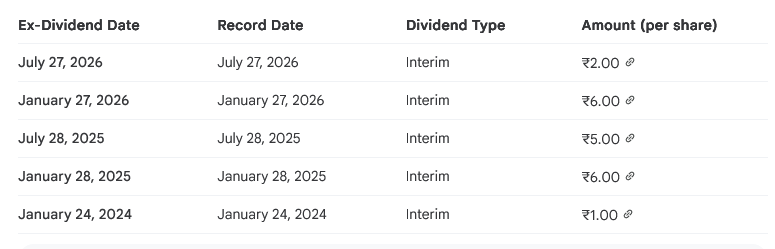
Wipro Limited (NSE:WIPRO) historically distributes its corporate earnings to shareholders via interim dividends.