
Table of Contents
Foreign investors are quietly increasing their exposure to several Indian small-cap companies — but which of these stocks still offer reasonable valuations?
FII & DII Buying Stocks: Top Indian Stocks Where Smart Money Is Increasing Stake in 2026
FII buying by itself does not guarantee that a stock will outperform. However, when foreign institutional accumulation, earnings growth and reasonable valuations appear together, the combination can provide an interesting starting point for investors looking for companies that may be receiving early institutional attention.
For this analysis, we screened companies using the latest Q1 FY27 shareholding data for the June 2026 quarter, along with P/E versus industry P/E, quarterly earnings growth and return on capital employed.
The objective is simple:
Find small-cap stocks where smart money is increasing exposure while the valuation has not yet become excessive.
Our screening framework gives greater weight to FII accumulation and valuation, while also considering earnings momentum and capital efficiency.
Important: This is a screening exercise, not a recommendation to buy any stock. Investors should independently verify the latest shareholding, valuation and financial results before taking any investment decision.
How We Screened These Smart Money Stocks
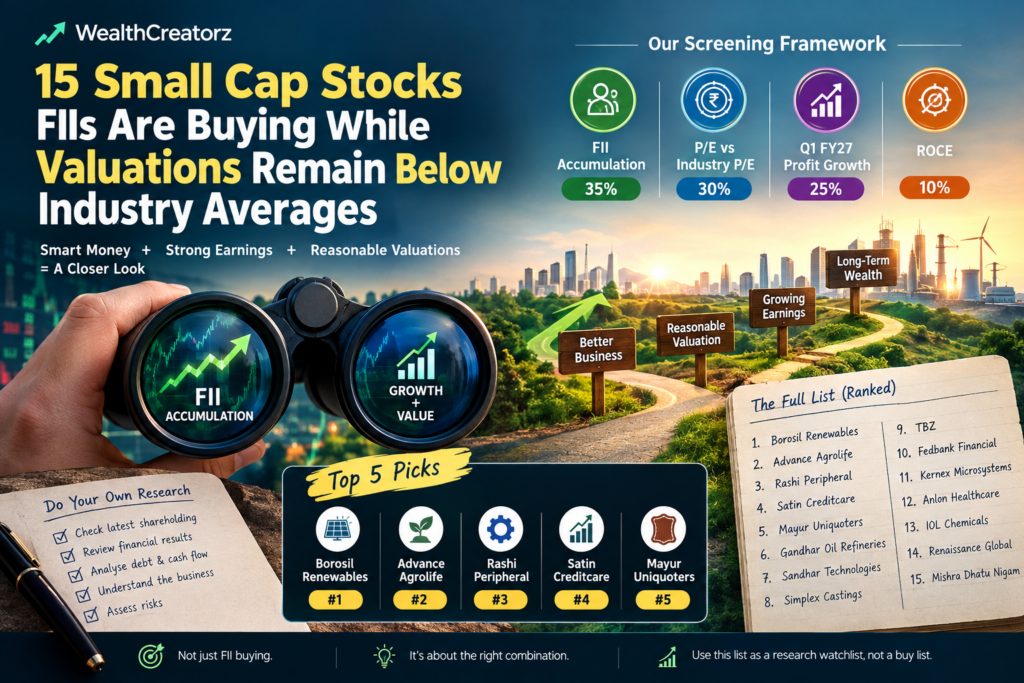
The screen focuses on four major factors:
| Factor | Weight |
|---|---|
| FII accumulation | 35% |
| Discount/premium to industry P/E | 30% |
| Q1 FY27 profit growth | 25% |
| ROCE | 10% |
Why these four factors?
FII accumulation indicates that foreign institutional investors have increased their exposure.
P/E versus industry P/E helps identify companies that are not trading at an obvious premium to their sector peers.
Profit growth provides a fundamental filter. A low valuation becomes more interesting when earnings are improving.
ROCE measures how efficiently a company generates operating returns from the capital employed in the business.
The June 2026 data is particularly relevant because Q1 FY27 results showed strong earnings momentum across Indian small- and mid-cap companies. Small- and mid-cap companies recorded approximately 29% and 31% PAT growth respectively in Q1 FY27, according to ET Intelligence Group data.
At the same time, small-cap funds attracted nearly ₹25,200 crore during the first four months of FY27, showing continued investor appetite for the segment.
Top 15 Small Cap Stocks FIIs Are Buying
The following ranking combines the four factors rather than ranking companies purely by the amount of FII buying.
| Rank | Stock | FII Holding Trend | P/E | Valuation vs Industry | Q1 FY27 Profit Growth | ROCE | Overall View |
|---|---|---|---|---|---|---|---|
| 1 | Borosil Renewables | ↑ | ~20x | Below industry | ~157% | ~27% | Strong combination |
| 2 | Advance Agrolife | ↑ | ~20x | Below industry | ~152% | ~20% | Growth + valuation |
| 3 | Rashi Peripheral | ↑ | ~18x | Below industry | ~71% | ~17% | Attractive screen |
| 4 | Satin Creditcare | ↑ | ~9x | Below industry | ~640% | ~14% | Deep value + earnings |
| 5 | Mayur Uniquoters | ↑ | ~16x | Below industry | ~38% | ~25% | Quality valuation |
| 6 | Gandhar Oil Refineries | ↑ | ~9x | Below industry | ~633% | ~13% | High earnings momentum |
| 7 | Sandhar Technologies | ↑ | ~18x | Below industry | ~33% | ~12% | Auto opportunity |
| 8 | Simplex Castings | ↑ | ~18x | Below industry | ~45% | ~24% | Strong capital efficiency |
| 9 | TBZ | ↑ | ~16x | Below industry | ~51% | ~22% | Consumer recovery |
| 10 | Fedbank Financial | ↑↑ | ~15x | Reasonable | ~53% | ~9% | Strong FII accumulation |
| 11 | Kernex Microsystems | ↑↑ | ~42x | Premium valuation | ~110%+ | ~48% | High growth, high valuation |
| 12 | Anlon Healthcare | ↑ | ~30x | Reasonable | ~88% | ~21% | High growth |
| 13 | IOL Chemicals | ↑↑ | ~30x | Below/near industry | ~68% | ~11% | Cyclical opportunity |
| 14 | Renaissance Global | ↑↑ | ~13x | Below industry | ~29% | ~8% | Value play |
| 15 | Mishra Dhatu Nigam | ↑ | ~65x | Premium valuation | ~27% | ~11% | Growth/thematic play |
Note: Figures are indicative screening data based on the June 2026/Q1 FY27 dataset and should be rechecked against the latest exchange/company filings before publication or investment decisions. The ranking is our screening methodology, not an analyst target-price ranking.
Screener’s June 2026 screens allow investors to filter companies based on P/E versus industry P/E, FII ownership, market capitalization, earnings growth and other fundamental variables.
1. Borosil Renewables
Why it ranks highly
Borosil Renewables stands out because it combines increasing FII participation, strong Q1 FY27 earnings growth and relatively attractive capital efficiency.
The company operates in the solar-glass industry, giving it exposure to India’s expanding renewable-energy manufacturing ecosystem.
The key attraction from this screen is not simply the FII buying.
It is the combination:
FII accumulation + strong profit growth + ROCE + reasonable valuation.
What investors should watch
The solar-glass industry is highly dependent on:
- Solar module manufacturing capacity
- Chinese imports and pricing
- Government policy
- Import duties
- Capacity utilization
- Commodity costs
Therefore, investors should not extrapolate one strong quarter indefinitely.
2. Advance Agrolife
Advance Agrolife is another interesting combination of institutional accumulation and strong earnings momentum.
The company reported strong Q1 FY27 profit and sales growth, while its ROCE remains at a level that makes the valuation more interesting than a simple high-growth stock.
Why it makes the list
The stock scores well because it combines:
- Rising FII exposure
- Strong quarterly earnings growth
- Reasonable P/E
- ROCE around 20%
The key question is whether the recent earnings acceleration can continue.
3. Rashi Peripheral
Rashi Peripheral is one of the more interesting valuation candidates in the screen.
The company has seen an increase in FII ownership while its valuation remains below the broader industry multiple.
The business also benefited from strong quarterly revenue and profit growth.
The investment thesis
The attraction is essentially:
Institutional buying without an extreme valuation premium.
However, investors should monitor margins, inventory, working capital and the competitive nature of the technology distribution business.
4. Satin Creditcare
Satin Creditcare is one of the most interesting deep-value candidates in this screen.
The company combines:
- Rising FII ownership
- Low single-digit/low-teens P/E territory
- Strong reported quarterly profit growth
- Improving earnings momentum
The enormous Q1 FY27 profit-growth number deserves caution, however.
A very high percentage growth rate can sometimes result from a low base, provisions, asset-quality changes or other one-off factors.
Therefore, investors should look at normalised earnings, asset quality and credit costs rather than simply extrapolating the headline growth rate.
5. Mayur Uniquoters
Mayur Uniquoters scores well because it combines a relatively modest valuation with healthy capital efficiency.
The company manufactures synthetic leather and related products used across sectors including automobiles and other applications.
Its screening profile is attractive because its P/E is below the industry multiple.
A separate June 2026 valuation screen shows Mayur Uniquoters trading at roughly 15x earnings against an industry P/E in the mid-20s.
What makes it interesting?
Reasonable valuation + improving earnings + healthy ROCE + FII interest.
This is exactly the type of combination our Smart Money Score is designed to identify.
6. Gandhar Oil Refineries
Gandhar Oil is one of the most eye-catching names in the screen.
The company recorded exceptionally strong Q1 FY27 profit growth while FII ownership also increased.
Its P/E remains relatively low compared with many high-growth small caps.
But there is an important warning.
Don’t blindly extrapolate the Q1 number
Gandhar’s earnings can be affected by commodity prices, inventory effects, margins and the performance of different business segments.
Therefore:
633% profit growth ≠ 633% sustainable annual growth.
The next few quarters will be much more important.
7. Sandhar Technologies
Sandhar Technologies provides exposure to India’s automotive manufacturing ecosystem.
The stock appears attractive in the screen because FII participation increased while quarterly earnings and sales also improved.
The company benefits from the long-term expansion of India’s automobile and component manufacturing ecosystem.
Key risks
Investors should monitor:
- OEM concentration
- Raw-material costs
- Margin expansion
- EV transition
- Working capital
- Auto-cycle slowdown
8. Simplex Castings
Simplex Castings is a smaller industrial company that stands out for its combination of earnings growth and relatively strong ROCE.
Its valuation is also below the broader industry multiple according to the June 2026 screening data.
This makes it particularly interesting for investors looking for lesser-known industrial companies receiving institutional attention.
However, liquidity and the cyclical nature of the business make risk management important.
9. TBZ
Tribhovandas Bhimji Zaveri, popularly known as TBZ, gives the screen exposure to India’s organised jewellery market.
The company recorded strong quarterly profit and revenue growth, while FII ownership increased.
The long-term investment thesis is linked to:
- Organised jewellery penetration
- Formalisation of the jewellery market
- Rising disposable income
- Brand expansion
- Store expansion
However, jewellery businesses are also sensitive to gold prices, consumer demand, working capital and inventory management.
10. Fedbank Financial
Fedbank Financial is arguably one of the most interesting names when looking specifically at FII accumulation.
Its FII holding increased significantly in the June 2026 quarter.
At the same time, quarterly earnings growth remained healthy and the stock’s valuation was not excessive compared with many high-growth financial companies.
Why it deserves attention
The combination is:
Large FII accumulation + earnings growth + moderate valuation.
For a financial company, however, investors should focus heavily on:
- GNPA
- NNPA
- Credit costs
- NIM
- ROA
- ROE
- Loan growth
- Collection efficiency
P/E alone is not enough.
11. Kernex Microsystems
Kernex is where the screen becomes much more speculative.
The company has reported exceptional earnings momentum and an extremely high ROCE.
Its business also provides exposure to India’s railway safety and technology spending.
But there is a major problem:
Valuation.
At more than 40x earnings, Kernex does not qualify as a conventional value stock.
It ranks because of its growth + FII accumulation + capital efficiency, not because it is cheap.
This distinction is important.
A great company can still be an expensive stock.
Therefore, Kernex should be placed in a higher-risk category rather than treated as a conventional undervalued stock.
12. Anlon Healthcare
Anlon Healthcare combines strong revenue and profit growth with improving institutional interest.
Its ROCE is also relatively healthy.
The company operates in the pharmaceutical/healthcare manufacturing space, giving investors exposure to the broader Indian pharmaceutical ecosystem.
The main question is whether its rapid growth can be sustained without putting pressure on margins or working capital.
13. IOL Chemicals
IOL Chemicals & Pharmaceuticals is another cyclical candidate.
The company combines:
- Increasing FII interest
- Earnings improvement
- Reasonable industrial valuation characteristics
Chemical companies require additional scrutiny because earnings can be highly cyclical.
Investors should therefore monitor:
- Realisations
- Raw-material prices
- Export demand
- Capacity utilisation
- Product mix
- EBITDA margins
14. Renaissance Global
Renaissance Global is one of the more interesting value-oriented candidates.
Its valuation is relatively modest compared with many small-cap growth stocks.
The company also has international exposure through the jewellery business.
The relatively low P/E makes it interesting, but the lower ROCE means it does not score as highly as the top-ranked candidates.
15. Mishra Dhatu Nigam
Mishra Dhatu Nigam is a special situation in this screen.
The company has exposure to India’s defence manufacturing ecosystem and therefore benefits from the long-term indigenisation of defence production.
However, the stock’s P/E is substantially higher than many of the other companies in our list.
Therefore, it should not be interpreted as an undervalued stock merely because FII ownership has increased.
Its inclusion is primarily because of institutional interest and the company’s strategic positioning.
The 5 Stocks That Stand Out Most
After combining the four factors, five companies deserve particular attention.
1. Borosil Renewables
Why: FII accumulation + earnings growth + ROCE + reasonable valuation.
2. Advance Agrolife
Why: Strong earnings momentum while valuation remains relatively moderate.
3. Rashi Peripheral
Why: Institutional interest + valuation discount + healthy earnings growth.
4. Satin Creditcare
Why: Low valuation + substantial earnings improvement + rising FII participation.
5. Mayur Uniquoters
Why: Attractive valuation relative to industry + healthy ROCE + earnings growth.
These should be viewed as screening leaders, not guaranteed outperformers.
The Most Interesting FII Accumulation Signal
One of the most important observations from the screen is Fedbank Financial.
Its FII holding increased by approximately 8.6 percentage points in the relevant quarter — substantially higher than most of the other names in this shortlist.
That makes it a stock worth investigating further.
But institutional accumulation needs context.
Ask:
Why did FIIs buy?
Was it:
- A fundamental re-rating?
- Index inclusion?
- A block transaction?
- A strategic investment?
- Improved earnings expectations?
- A change in ownership structure?
The reason behind the buying can be as important as the percentage increase itself.
Don’t Ignore the Valuation Discount
A common mistake investors make is looking only at the P/E ratio.
A P/E of 20x can be expensive for one industry and cheap for another.
That is why this screen compares:
Company P/E vs Industry P/E
For example, June 2026 screening data shows companies such as Mayur Uniquoters and Simplex Castings trading below their respective industry P/E multiples.
This doesn’t automatically mean the stocks are undervalued.
The market may be assigning a lower multiple because of:
- Lower growth expectations
- Poor historical returns
- Higher cyclicality
- Weak cash flow
- Governance concerns
- Customer concentration
- Small-cap liquidity
- Industry disruption
Therefore, P/E discount is a starting point, not a buy signal.
FII Buying + Earnings Growth: The Combination Investors Should Watch
The most powerful combination in this screen is:
FII Holding ↑
AND
Profit Growth ↑
AND
P/E < Industry P/E
AND
ROCE is healthy
When all four appear together, the stock becomes much more interesting for further research.
This is fundamentally different from simply searching for stocks where FIIs bought shares.
What Could Go Wrong?
A smart-money screen also has several limitations.
1. FII buying can be temporary
Foreign investors can change positions rapidly because of global liquidity, currency movements or portfolio rebalancing.
2. One-quarter earnings growth can be misleading
A 500% or 600% profit increase can look spectacular but may be caused by a low base.
3. Small caps are volatile
A company can have excellent fundamentals and still experience a 30–50% correction.
4. Industry P/E is not a perfect valuation benchmark
Different companies within the same industry can deserve very different multiples.
5. Liquidity matters
Smaller stocks can have wide bid-ask spreads and limited trading volumes.
6. FII ownership does not guarantee future returns
Institutional investors can be wrong — and they can also sell.
A Better Way to Use This List
Rather than buying all 15 stocks, investors can use this screen as a research funnel.
Stage 1 — Smart Money
Look for:
FII holding ↑
↓
Stage 2 — Valuation
Check:
P/E < Industry P/E
↓
Stage 3 — Earnings
Check:
Profit growth + Revenue growth
↓
Stage 4 — Quality
Check:
ROCE + Debt + Cash Flow
↓
Stage 5 — Ownership
Check:
Promoter holding + DII holding + promoter pledging
↓
Stage 6 — Technical Setup
Finally examine:
Price trend + volume + support/resistance
Only after all six stages should an investor consider whether a stock deserves a place on a watchlist.
5 Stocks That Need the Most Caution
Not every stock with FII buying is automatically attractive.
Kernex Microsystems
Excellent growth and ROCE, but valuation is demanding.
Mishra Dhatu Nigam
Strong defence theme, but valuation leaves less room for disappointment.
Anlon Healthcare
High growth needs to be sustained.
Gandhar Oil
Extremely strong reported earnings growth needs normalisation.
Satin Creditcare
Financial-sector investors need to track asset quality and credit costs rather than relying solely on headline profit growth.
The Bigger Picture: Are FIIs Returning to Small Caps?
The broader market backdrop is supportive but still needs to be monitored.
Indian small- and mid-cap companies delivered stronger Q1 FY27 earnings growth than large caps, while small-cap funds attracted substantial inflows during the opening months of FY27.
India’s economy also expanded by 7.8% in the April–June 2026 quarter, exceeding market expectations, with investment, manufacturing and services contributing to growth.
However, macro risks remain.
Higher global bond yields, crude-oil volatility, currency movements and global risk appetite can quickly influence FII flows.
Therefore, the best approach is not:
“FIIs are buying, so buy.”
It is:
“FIIs are buying — now let’s investigate whether the business fundamentals and valuation justify following them.”
Final Ranking
WealthCreatorz Smart Money Watchlist
| Rank | Stock | Primary Attraction | Main Risk |
|---|---|---|---|
| 1 | Borosil Renewables | Growth + valuation + FII accumulation | Solar-glass cyclicality |
| 2 | Advance Agrolife | Earnings growth + reasonable valuation | Sustainability of growth |
| 3 | Rashi Peripheral | FII buying + valuation discount | Competitive industry |
| 4 | Satin Creditcare | Low valuation + earnings recovery | Credit quality |
| 5 | Mayur Uniquoters | Value + ROCE | Auto-cycle |
| 6 | Gandhar Oil | Earnings momentum + low P/E | Commodity cyclicality |
| 7 | Sandhar Technologies | Auto growth + FII interest | OEM concentration |
| 8 | Simplex Castings | ROCE + valuation | Small-cap liquidity |
| 9 | TBZ | Jewellery growth | Gold/working capital |
| 10 | Fedbank Financial | Strong FII accumulation | Financial-sector risks |
| 11 | Kernex Microsystems | Growth + high ROCE | High valuation |
| 12 | Anlon Healthcare | Strong earnings growth | Growth sustainability |
| 13 | IOL Chemicals | Earnings recovery | Chemical cyclicality |
| 14 | Renaissance Global | Low valuation | Lower capital efficiency |
| 15 | Mishra Dhatu Nigam | Defence opportunity | High valuation |
Conclusion
The most interesting small-cap opportunities are not necessarily the companies with the highest FII buying.
The more useful signal is where several indicators converge:
FII accumulation + earnings growth + valuation discount + capital efficiency.
On that basis, Borosil Renewables, Advance Agrolife, Rashi Peripheral, Satin Creditcare and Mayur Uniquoters emerge as the five strongest candidates from this particular screening framework.
At the other end, Kernex Microsystems and Mishra Dhatu Nigam demonstrate why investors should not confuse institutional buying with undervaluation.
The key takeaway is simple:
Smart money becomes much more interesting when it is buying a company before the valuation fully reflects improving fundamentals.
This list should therefore be treated as a research watchlist rather than a buy list.
Before investing, investors should verify the latest exchange filings, June 2026 shareholding pattern, September-quarter developments, debt, cash flow, promoter pledging and current valuation because stock prices and institutional holdings can change after the June-quarter data used in this screen.
Disclaimer: This article is for educational and informational purposes only and is not investment advice or a recommendation to buy or sell any security.
3 thoughts on “15 Small Cap Stocks FIIs Are Buying Below Industry P/E”