
Table of Contents
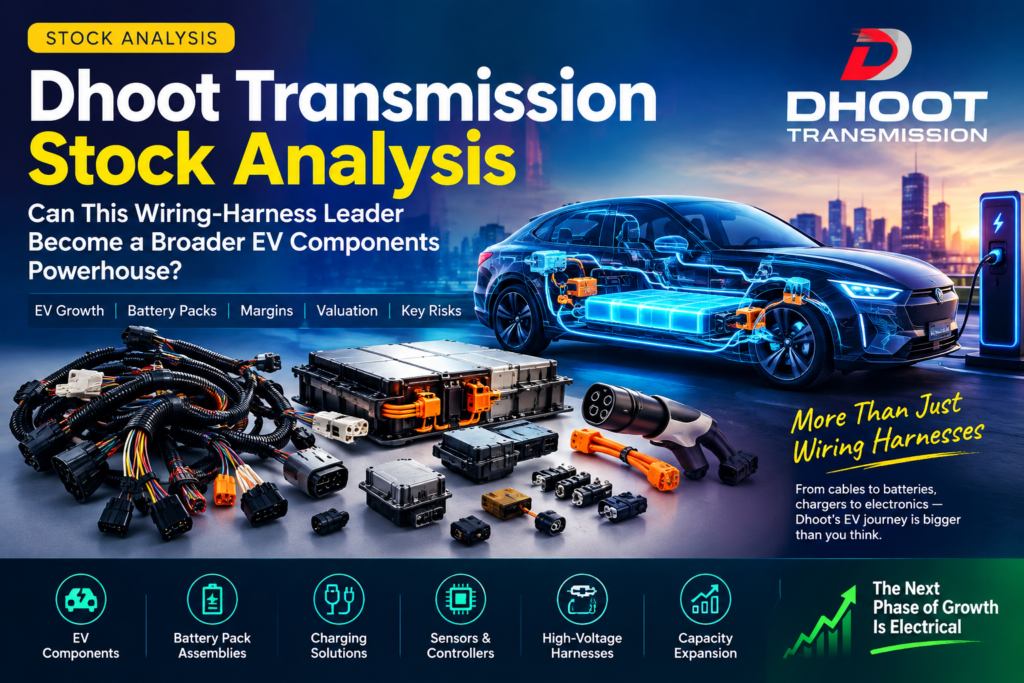
Dhoot Transmission Stock Analysis: Can This Wiring-Harness Leader Become a Broader EV Components Powerhouse?
India’s automobile industry is entering a structural transition.
The shift from internal-combustion-engine vehicles to electric vehicles is not simply changing the power source of automobiles. It is also increasing the amount of electrical, electronic and high-voltage content inside each vehicle.
15 Small Cap Stocks FIIs Are Buying Below Industry P/E
This creates an interesting opportunity for companies that can move beyond traditional auto components and participate in multiple parts of the EV ecosystem.
Dhoot Transmission is one such company.
Historically known for its strong position in wiring harnesses for two-wheelers and three-wheelers, the company is now attempting to transform itself into a broader electrical and electronics platform serving the automotive industry.
Its portfolio increasingly includes:
- Wiring harnesses
- EV battery-pack assemblies
- High-voltage harnesses
- EV chargers
- Charging guns and cordsets
- Power distribution units
- Sensors
- Electronic controllers
- Automotive switches
- Connectors and terminals
- Vehicle-to-load systems
- Other electrical and electronic components
The strategy is important because Dhoot does not necessarily need EV adoption to replace its existing business. Instead, it can potentially increase the value of content supplied per vehicle as vehicles become more electrified and electronically complex.
The latest Q1 FY27 numbers provide evidence that this strategy is gaining traction.
Dhoot Transmission reported approximately ₹1,446 crore of revenue in Q1 FY27, up nearly 50% year-on-year, while EV revenue increased 79% and reached approximately 27% of total revenue.
Management has also maintained its FY27 guidance of 25–30% revenue growth and 15–16% EBITDA margins.
But there is another side to the story.
Customer concentration remains high, copper prices can temporarily pressure margins, newer businesses still need to scale, and the stock has been assigned a premium valuation because investors are already pricing in substantial future growth.
So, is Dhoot Transmission merely a wiring-harness company with an EV narrative—or could it become a diversified EV electrical-component platform?
Let’s examine the business.
Dhoot Transmission: Company Overview
Dhoot Transmission was established in 1998 and has built a significant presence in automotive electrical components.
Its historical strength has been wiring harnesses, particularly for the two-wheeler and three-wheeler industry.
The company supplies components to major OEMs and has developed long-standing relationships with customers across the automotive ecosystem.
The traditional wiring-harness business remains the company’s largest revenue contributor.
However, management is deliberately increasing the contribution of non-wiring products.
That shift could ultimately become one of the most important aspects of the investment thesis.
According to the research provided, wiring harnesses represented roughly 77% of FY26 revenue, while non-wiring businesses had already increased to approximately 23%.
The company is therefore moving from:
“We supply wiring harnesses”
toward:
“We provide electrical and electronic systems across the vehicle.”
That is a much bigger opportunity.
Why EVs Could Be a Major Growth Driver
The most important structural argument behind Dhoot Transmission is simple:
EVs require substantially more electrical content than conventional vehicles.
An internal-combustion vehicle needs wiring, sensors and electronic systems.
An EV needs those systems plus:
- Battery-related wiring
- High-voltage interconnections
- Battery-management interfaces
- Charging systems
- Power distribution
- Additional sensors
- Controllers
- DC-DC conversion
- Thermal-management interfaces
- More sophisticated electrical architecture
This means EV penetration can increase component content even if total vehicle volumes do not grow dramatically.
Dhoot’s management has indicated that its complete product portfolio can result in significantly higher content per EV compared with a conventional ICE vehicle.
This creates a potential double growth engine:
Automobile volumes ↑ + electrical content per vehicle ↑
That combination is particularly attractive for an auto-component supplier.
Q1 FY27: The EV Story Is Becoming Visible in the Numbers
The company’s latest quarter provides perhaps the clearest evidence yet that the strategy is working.
Q1 FY27 performance
| Metric | Q1 FY27 |
|---|---|
| Revenue from operations | ~₹1,446 Cr |
| YoY revenue growth | ~50% |
| Wiring-harness growth | 44.6% |
| Non-wiring growth | 67.7% |
| EV revenue growth | 79% |
| EV revenue contribution | ~27% |
| EBITDA | ~₹218 Cr |
| EBITDA margin | ~15.1% |
| PAT | ~₹132.7 Cr |
The company reported wiring-harness revenue of approximately ₹1,090 crore and non-wiring revenue of about ₹358 crore during Q1 FY27.
This is significant because non-wiring revenue is growing faster than the core wiring business.
That is exactly what investors would want to see if Dhoot is attempting to diversify its revenue mix.
Non-Wiring Business: The More Interesting Part of the Story?
The wiring-harness business is already established.
The potentially larger opportunity lies in the products being built around it.
Non-wiring products include:
- Battery packs
- Sensors
- Controllers
- Switches
- Connectors
- Power electronics
- Other electronic components
Non-wiring revenue increased to approximately 23% of FY26 revenue and grew roughly 68% year-on-year in Q1 FY27.
This creates an important strategic shift.
Instead of earning revenue only from the electrical “nervous system” of the vehicle, Dhoot is attempting to supply several components within that system.
That potentially increases:
Revenue per vehicle → customer stickiness → cross-selling opportunities → addressable market
Dhoot Transmission’s EV Battery-Pack Business
Battery packs are one of the company’s most interesting newer businesses.
However, investors need to understand exactly what Dhoot is—and is not—doing.
Dhoot is not a lithium-ion cell manufacturer.
Instead, customers generally provide the imported battery cells.
Dhoot performs value-added assembly and component integration.
Its work can include:
- Cell holders
- Bus bars
- Internal harnesses
- Pressure sensors
- Connection systems
- Welding
- Testing
- Pack assembly
- Integration
This distinction matters.
A battery manufacturer that purchases cells itself carries substantial cell-cost and inventory exposure.
Dhoot’s free-issued-cell model allows it to focus on the value-added portion of battery-pack assembly.
The company’s research indicates that a second major two-wheeler customer began receiving battery-pack supplies during Q1 FY27, helping diversify the business.
Are Battery Packs More Profitable Than Wiring Harnesses?
This is an important question.
The answer is:
There is currently no clean publicly disclosed standalone EBITDA margin for Dhoot’s battery-pack assembly business.
Management has indicated that margins are broadly similar across ICE and EV products rather than battery packs being dramatically more profitable or less profitable.
The company’s overall FY27 sustainable EBITDA margin guidance remains approximately 15–16%.
Therefore, investors should be cautious about assuming:
Battery packs = huge margin expansion.
The better way to view the opportunity is:
Battery packs = incremental content + EV exposure + customer diversification + broader product capability.
That could be valuable even without dramatically higher margins.
Why the Free-Issued Cell Model Matters
One attractive feature of the battery-pack business is that the expensive battery cells are generally supplied by customers.
Dhoot’s value addition comes from components and assembly.
This can reduce:
- Cell-price exposure
- Inventory risk associated with cells
- Working-capital requirements associated with purchasing cells
- Commodity volatility directly attributable to battery cells
At the same time, the company can capture value through its internal manufacturing capabilities.
This creates an interesting business model:
Customer supplies cells → Dhoot adds components + engineering + assembly → Dhoot earns value-added revenue
The company can potentially improve the economics further through backward integration into holders, bus bars, connectors and harnesses.
EV Charging: Another Potential Growth Engine
Battery packs are not the only EV opportunity.
Dhoot is also expanding into charging-related products.
These include:
- EV chargers
- Charging guns
- Charging cordsets
- Power distribution units
- V2L adapters
- High-voltage assemblies
This matters because the EV electrical ecosystem is much broader than the battery itself.
If Dhoot successfully develops relationships across multiple EV electrical systems, its potential revenue opportunity per vehicle could increase significantly.
Management has also highlighted the company’s presence across the broader EV powertrain rather than being restricted to one product category.
High-Voltage Systems Could Become a Key Opportunity
High-voltage architecture is an important part of EVs.
As vehicles become more powerful and charging speeds increase, high-voltage systems become increasingly important.
Dhoot is expanding into:
- High-voltage harnesses
- Power distribution systems
- Related electrical assemblies
This provides an opportunity to move higher up the technology chain.
It could also help the company participate in larger vehicle categories over time.
Management has discussed opportunities around passenger-vehicle high-voltage wiring as well as broader OEM relationships.
However, investors should distinguish between potential programmes and commercial revenue already reflected in financial statements.
Not every announced partnership or potential customer becomes a material revenue contributor.
Multilink Acquisition: Why It Matters
Another important development is Dhoot’s integration of Multilink.
The acquisition adds products such as:
- Fuel-level sensors
- Relays
- Other electronic components
More importantly, it provides access to Hero MotoCorp as a customer relationship.
Management has indicated that full integration would take approximately three to four months and expects Multilink to deliver around 25–30% growth, with margins broadly in line with Dhoot Transmission.
The strategic opportunity is potentially larger than the acquired revenue itself.
Cross-selling.
If Multilink supplies products to customers that Dhoot already serves, Dhoot can potentially introduce additional products.
Likewise, Dhoot’s existing customer relationships could become an avenue for Multilink’s products.
This can create a flywheel:
Acquisition → New customer/product → Cross-selling → Higher revenue → Better capacity utilisation
The success of that strategy should be monitored over the next few quarters.
Capacity Expansion: Is Dhoot Preparing for Higher Demand?
Yes.
Dhoot has been investing heavily in capacity.
The company has spent roughly ₹1,000 crore over several years on capital expenditure, according to management commentary and industry reporting.
Further expansion is underway at facilities including Jhajjar and Hosur.
Management has indicated that these initiatives can increase capacity by roughly 15–20% during FY27.
This is important because capacity constraints can become a bottleneck if demand continues growing at 25–30%.
However, capacity expansion also creates execution risk.
Investors need to monitor:
- Capex spending
- Commissioning timelines
- Capacity utilisation
- New programme wins
- Return on invested capital
- Working-capital requirements
Building capacity is easy compared with filling that capacity profitably.
Dhoot Transmission FY26 Financial Performance
The company’s long-term growth trajectory has been strong.
According to financial data, FY26 revenue was approximately ₹4,525 crore, compared with ₹3,445 crore in FY25, representing growth of roughly 31%.
FY26 earnings were approximately ₹397 crore, according to reported financial data.
Another annual financial dataset reports FY26 total income of approximately ₹4,527 crore and EBITDA of roughly ₹371 crore on its accounting presentation.
The precise presentation can vary depending on whether one uses standalone/consolidated figures and the accounting line item being compared, so investors should rely on the company’s audited consolidated financial statements for detailed modelling.
The larger point is clear:
Dhoot has been growing rapidly even before the current EV expansion fully matures.
Q1 FY27 Profit Growth
Q1 FY27 was another strong quarter.
Reported consolidated PAT was approximately ₹132.7 crore, while EBITDA was around ₹218 crore.
PAT increased strongly year-on-year.
The quarterly numbers therefore suggest that the company’s growth is not simply revenue growth without earnings conversion.
However, margin performance needs to be watched carefully.
EBITDA Margins: The Key Near-Term Question
The company has guided for:
FY27 EBITDA margin: 15–16%
Q1 FY27 EBITDA margin was approximately 15.1%.
That represented an improvement of about 110 basis points sequentially, although it remained below the year-ago level because of commodity-cost pressure.
This creates an important investor debate:
Can Dhoot grow revenue by 25–30% while maintaining 15–16% EBITDA margins?
If yes, earnings growth could remain strong.
If margins fall materially below guidance, investors may start questioning whether the rapid revenue growth is translating into adequate incremental profitability.
Copper: The Most Important Commodity Risk
Copper is particularly important to Dhoot because wiring harnesses contain a significant amount of copper and related materials.
The company estimates copper represents roughly 22–23% of its broader bill of materials.
That creates a structural margin sensitivity.
When copper prices rise:
Input cost ↑ → Gross margin pressure → EBITDA margin pressure
But Dhoot has a price-escalation mechanism with customers.
The catch is:
There is a lag.
Management has indicated that the pass-through generally occurs with approximately a three-month lag.
This means copper movements can create temporary earnings volatility.
How the Copper Pass-Through Mechanism Works
Imagine copper prices suddenly increase sharply.
Dhoot’s costs rise immediately.
But the corresponding customer price revision may happen later.
For several months:
Costs rise faster than revenue realisation
and margins can therefore contract.
Once the price adjustment reaches customers:
Revenue recovery catches up → margin pressure normalises
The same mechanism can work in reverse.
If copper prices decline, Dhoot may temporarily benefit before the lower input cost is fully passed on to customers.
Therefore:
Copper price volatility matters more for quarterly margins than for the long-term economics of the business.
The Q1 FY27 margin decline was attributed largely to the commodity cycle rather than a deterioration caused by the increasing battery/non-wiring mix.
Could Margins Recover in FY27?
Management remains confident about the 15–16% full-year EBITDA margin range.
Recent commentary suggested that much of the earlier copper inflation had already been passed through, although copper had risen further during July and August.
Because of the lag, the effect of subsequent commodity movements can take time to appear in reported results.
Therefore, investors should not judge the entire year’s margin trajectory based on one quarter.
Instead, track:
Q2 FY27 → Q3 FY27 → Q4 FY27
and particularly look for:
- Gross-margin recovery
- EBITDA margin stabilisation
- Commodity pass-through
- Operating leverage
- Capacity utilisation
Customer Concentration: The Biggest Structural Risk?
Perhaps the most important risk that investors should not overlook is customer concentration.
Dhoot has developed strong relationships with major two-wheeler OEMs.
But a small number of customers account for a substantial portion of revenue.
Industry reporting indicates that the top five customers represented more than 70% of FY26 revenue, while the top ten accounted for more than 80%. Bajaj Auto has historically represented roughly one-third of revenue.
This creates a significant risk.
Suppose a major customer:
- Changes sourcing strategy
- Reduces production
- Develops more components internally
- Switches suppliers
- Faces a prolonged slowdown
Dhoot’s revenue could be affected disproportionately.
This is why customer diversification should be considered one of the most important KPIs for the company.
Why Customer Concentration May Decline Over Time
There are several potential diversification mechanisms.
1. More customers
Dhoot continues to add OEM relationships.
2. More products
The company can sell multiple components to existing customers.
3. Acquisitions
Multilink adds another customer ecosystem.
4. EV expansion
EV platforms can open additional product opportunities.
5. Passenger vehicles and commercial vehicles
Expansion beyond two-wheelers could broaden the customer base and end-market exposure.
If these initiatives succeed, the company could gradually move from:
Few customers × few products
toward:
More customers × more products × more vehicle categories
That would improve business resilience.
Two-Wheeler Concentration: Opportunity and Risk
Dhoot’s two-wheeler focus is both an advantage and a risk.
India has a massive two-wheeler market.
EV penetration is rising particularly rapidly in electric two-wheelers and three-wheelers.
That gives Dhoot a strong structural opportunity.
But it also means the company is exposed to:
- Two-wheeler demand
- Rural/urban consumption trends
- Financing availability
- Regulatory changes
- EV subsidy policies
- OEM production volumes
Diversification into passenger vehicles and commercial vehicles could therefore become strategically important.
Dhoot’s Competitive Advantage
What could prevent another component manufacturer from simply copying Dhoot’s strategy?
The company has several potential competitive advantages.
1. Scale in wiring harnesses
Dhoot already has significant market share in two-wheeler/three-wheeler wiring harnesses.
Industry reports put its overall two-wheeler wiring-harness share at around 38%, while the company’s own positioning is particularly strong in electric applications.
2. OEM relationships
Long-standing relationships can create switching costs.
3. Manufacturing capability
The company has developed capabilities across multiple electrical components.
4. Backward integration
Internal manufacturing of components such as connectors, terminals and related parts can improve control over the value chain.
5. Engineering capability
Dhoot has expanded its engineering and R&D capabilities as its product portfolio becomes more complex.
6. EV positioning
The company is already participating in several parts of the EV electrical architecture.
The “Content Per Vehicle” Investment Thesis
This may be the most important concept for understanding Dhoot Transmission.
An investor might initially think:
“If India’s two-wheeler market grows 8–10%, why should Dhoot grow 25–30%?”
The answer lies in content per vehicle.
Consider a simplified example.
Suppose Dhoot earns ₹X of revenue from an ICE vehicle.
An EV could require:
- More wiring
- High-voltage harnesses
- Battery-related assemblies
- Sensors
- Controllers
- Charging components
- Additional connectors
- Power-distribution systems
Therefore, Dhoot could potentially earn several times more content from the same vehicle platform.
That means:
Vehicle volume growth + EV penetration + content expansion = potentially much faster component revenue growth.
This is why the EV transition could be more powerful for Dhoot than simply tracking overall vehicle production.
EV Revenue Could Cross 30% of Sales
Dhoot’s EV revenue already represented approximately 27% of total revenue in Q1 FY27, compared with 24% a year earlier.
EV revenue grew approximately 79% year-on-year.
Management expects the EV contribution to exceed roughly 30–32% over the next two to three years.
If this happens alongside continued non-wiring growth, Dhoot’s business mix could look meaningfully different from its historical profile.
That is potentially one of the biggest valuation drivers.
IPO and Balance Sheet: Why the 2026 Listing Matters
Dhoot Transmission became a publicly listed company in 2026.
The IPO involved a fresh issue as well as an offer for sale, with the shares listing on NSE and BSE.
The fresh capital provides the company with additional financial flexibility for:
- Capacity expansion
- Technology investments
- Working capital
- Debt reduction
- Strategic acquisitions
- Joint ventures
Management has also indicated that the company’s debt position improved significantly following the equity infusion, with approximately ₹220 crore of debt at the end of June and an expectation of a substantial net-cash position after the IPO proceeds were deployed.
A stronger balance sheet is important because the company’s strategy requires capital.
Multilink + EV + Capacity: Three Growth Engines
Dhoot’s growth strategy can effectively be divided into three buckets.
Growth Engine 1: Core Wiring Harness
The existing business continues to benefit from:
- Automobile production
- EV adoption
- Premiumisation
- Higher electrical content
Growth Engine 2: Non-Wiring Products
These include:
- Battery packs
- Sensors
- Controllers
- Switches
- Relays
- Charging systems
Growth Engine 3: New Customers + New Vehicle Categories
This includes:
- Multilink
- Hero MotoCorp relationship
- Potential passenger-vehicle opportunities
- Commercial-vehicle opportunities
- New OEM programmes
If all three grow simultaneously, Dhoot could sustain a growth rate meaningfully above the underlying automobile industry.
What Could Go Right?
The bull case for Dhoot Transmission rests on several factors.
Bull Case
1. EV adoption accelerates
Higher EV penetration increases electrical content per vehicle.
2. Non-wiring revenue grows faster
The company gradually becomes less dependent on traditional harnesses.
3. EV revenue exceeds 30%
This could strengthen the company’s growth profile.
4. Battery-pack customers diversify
Dependence on a few customers declines.
5. Multilink cross-selling works
Existing OEM relationships generate additional revenue opportunities.
6. Capacity expansion gets absorbed
New plants operate at healthy utilisation.
7. Copper prices stabilise
Margin pressure reduces as pass-through catches up.
8. New products scale
Charging, high-voltage systems, sensors and electronics become meaningful revenue contributors.
9. Passenger-vehicle penetration increases
The addressable market expands beyond two-wheelers and three-wheelers.
If several of these factors occur together, the company’s earnings trajectory could remain strong.
What Could Go Wrong?
The bear case is equally important.
Bear Case
1. EV adoption slows
Lower EV penetration reduces the expected content expansion.
2. Customer concentration remains high
The company continues to depend heavily on a handful of OEMs.
3. Copper remains elevated
Repeated commodity increases could keep margins under pressure.
4. Pass-through gets delayed
OEM negotiations could extend the margin compression period.
5. New businesses scale slowly
Battery packs, charging products and high-voltage systems may take longer to become meaningful.
6. Capacity gets ahead of demand
Excess capacity could hurt return on capital.
7. Competition increases
Other auto-component manufacturers may enter the same EV component categories.
8. Acquisition integration disappoints
Multilink may fail to generate the expected cross-selling benefits.
9. Valuation compresses
Even if earnings grow, the stock can fall if investors become unwilling to pay the same premium multiple.
That last point is particularly important.
Valuation: Growth Is Not Enough
Dhoot Transmission is an interesting example of why investors should separate:
Business quality
from
Stock valuation.
A company can grow revenue by 25–30% and still produce poor stock returns if investors have already priced in even higher growth.
The stock’s premium valuation reflects expectations around:
- EV growth
- Market share
- Non-wiring expansion
- Margin resilience
- Customer relationships
- Future product expansion
Therefore, investors should not simply ask:
“Is Dhoot Transmission a good company?”
They should ask:
“How much future growth is already reflected in the current valuation?”
That is a much better investment question.
What Investors Should Monitor Every Quarter
Instead of focusing only on revenue and PAT, investors should build a Dhoot Transmission dashboard.
1. Revenue Growth
Is the company maintaining its 25–30% FY27 growth trajectory?
2. EV Revenue
Is EV revenue continuing to grow faster than the company overall?
3. EV Revenue Mix
Is the contribution moving toward the targeted 30–32%+ range?
4. Non-Wiring Revenue
Is non-wiring consistently outgrowing wiring harnesses?
5. EBITDA Margin
Is the company maintaining the 15–16% guidance?
6. Copper Prices
Are raw-material pressures increasing or declining?
7. Pass-Through
Is the three-month pricing lag causing temporary or persistent margin pressure?
8. Customer Concentration
Is dependence on Bajaj and other major customers declining?
9. Capacity Utilisation
Are new capacities being absorbed efficiently?
10. Multilink
Is the acquisition generating the expected 25–30% growth and cross-selling?
11. Battery Packs
Are new battery-pack customers being added?
12. Free Cash Flow
Is earnings growth translating into cash generation?
Dhoot Transmission vs Traditional Auto-Ancillary Model
The key question is whether Dhoot deserves to be valued like a conventional wiring-harness manufacturer.
A traditional auto ancillary generally grows with:
Vehicle production × content per vehicle
Dhoot is trying to build something different:
Vehicle production × EV penetration × electrical content × products per vehicle × customer diversification
If management succeeds, the second model could produce structurally higher growth.
But the market knows this.
Therefore, investors may already assign the company a higher multiple.
This creates a classic:
Growth vs Valuation trade-off.
The Most Important Question: Can Dhoot Become an EV Platform?
This is ultimately what investors should watch.
Dhoot does not need to become a battery-cell manufacturer or a complete EV system provider.
It could potentially build a strong niche as an electrical and electronics platform for automotive OEMs.
Imagine a future vehicle where Dhoot supplies:
- Low-voltage harness
- High-voltage harness
- Battery-pack components
- Sensors
- Controllers
- Connectors
- Charging cordsets
- PDU
- Switches
- Other electronic assemblies
The amount of content supplied per vehicle could be dramatically higher than in its historical wiring-only model.
That is the strategic transformation investors are paying for.
Dhoot Transmission Stock: Strengths and Weaknesses
| Strengths | Risks |
|---|---|
| Strong 2W/3W wiring-harness position | High customer concentration |
| Rapid EV revenue growth | Copper-price sensitivity |
| Non-wiring business growing faster | Three-month pass-through lag |
| Battery-pack opportunity | Premium valuation |
| EV charging opportunity | Execution risk |
| High-voltage expansion | Competition |
| Multilink cross-selling | Capacity-utilisation risk |
| Strong OEM relationships | Two-wheeler concentration |
| Capacity expansion | New products still scaling |
| Improving product diversification | Acquisition integration risk |
Dhoot Transmission: Key Numbers at a Glance
| Parameter | Latest/Indicative Position |
|---|---|
| Q1 FY27 Revenue | ~₹1,446 Cr |
| Q1 FY27 Revenue Growth | ~50% YoY |
| Q1 FY27 EBITDA | ~₹218 Cr |
| Q1 FY27 EBITDA Margin | ~15.1% |
| Q1 FY27 PAT | ~₹132.7 Cr |
| Wiring Revenue Growth | 44.6% |
| Non-Wiring Revenue Growth | 67.7% |
| EV Revenue Growth | 79% |
| EV Revenue Mix | ~27% |
| FY27 Revenue Guidance | 25–30% |
| FY27 EBITDA Margin Guidance | 15–16% |
| Expected EV Mix in 2–3 Years | >30–32% |
| Capacity Expansion FY27 | ~15–20% |
| Copper in BOM | ~22–23% |
| Copper Pass-through Lag | ~3 months |
Q1 FY27 financial figures and management guidance are based on the company’s latest reported quarter and associated earnings commentary.
Final Verdict: Is Dhoot Transmission an EV Play or a Wiring-Harness Company?
The answer is increasingly:
Both—but the mix is changing.
Dhoot Transmission remains fundamentally a wiring-harness company today.
But its future growth opportunity is increasingly connected to:
EVs + electronics + batteries + high-voltage systems + charging + sensors + controllers.
The Q1 FY27 numbers are encouraging.
Revenue increased nearly 50%, EV revenue increased 79%, non-wiring revenue grew faster than wiring, and management retained its 25–30% FY27 growth guidance.
The company’s strategy therefore appears to be moving in the right direction.
However, investors should not ignore the risks.
The three most important are:
1. Customer concentration
A large percentage of revenue remains dependent on a relatively small number of OEMs.
2. Commodity volatility
Copper can create temporary but meaningful margin pressure because customer price adjustments occur with a lag.
3. Valuation
A large part of the company’s future growth story may already be reflected in the stock price.
The investment thesis becomes much stronger if Dhoot can simultaneously achieve:
25–30% growth + 15–16% EBITDA margins + rising EV mix + faster non-wiring growth + customer diversification.
If that combination persists for several years, Dhoot could evolve from a traditional auto-component supplier into a much broader automotive electrical and electronics platform.
But if growth slows, margins disappoint or the market de-rates premium EV-linked auto-component stocks, the downside could be significant even if the underlying business remains fundamentally sound.
The key takeaway for investors
Dhoot Transmission is not simply an EV battery-pack story.
The bigger thesis is the rising electrical content per vehicle.
Battery packs are only one part of that opportunity.
The more interesting long-term question is whether Dhoot can use its existing wiring-harness leadership and OEM relationships to become a diversified supplier of the electrical architecture of India’s next generation of vehicles.
That transformation—not any single quarterly number—is what investors should watch.
Important Investor Disclaimer
This article is for informational and educational purposes only and should not be considered investment advice, a buy/sell recommendation or a target-price call. Investors should independently verify financial statements, valuation multiples, company filings, management commentary and current market prices before making any investment decision.
Past growth does not guarantee future performance. Auto-component businesses can be affected by OEM production, commodity prices, foreign-exchange movements, customer concentration, technology changes, capital expenditure and competitive intensity.