
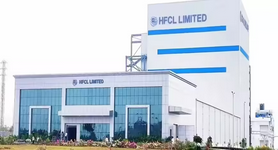
HFCL secured a ₹2,666.09 crore contract from Rail Vikas Nigam Limited for BharatNet Phase-III in Uttar Pradesh (West).
The contract structure fundamentally alters HFCL’s revenue profile: ₹1,192.82 crore in capex and ₹1,473.27 crore in opex, with a 2-year implementation period followed by 10 years of maintenance.
With this setup, HFCL will book heavy capex revenue early on during the construction phase, before locking in a predictable, high-margin revenue stream averaging ₹147 crore every year for the next decade.
Because the opex portion offers higher profit margins than traditional engineering contracts, it secures a predictable revenue stream that cements HFCL’s leadership in India’s digital expansion.
HFCL’s total order book has climbed to ₹21,200 crore, anchored by a massive ₹12,250 crore in international orders that ensures robust revenue visibility for the coming years.
To ensure smooth execution, leadership is scaling up optical fiber production from 28 million fkm to 33.9 million fkm by December 2026.
How does HFCL plan to fund its operational liquidity needs during the initial 2-year infrastructure rollout before the recurring maintenance income begins?
The ₹2,666 crore BharatNet Phase-III contract is HFCL’s largest single order and introduces a 2-year capex-intensive execution phase before the steady ₹147 crore/year opex revenue kicks in.
Here’s a structured breakdown of how HFCL is positioned to manage this:
The Upfront Cash Flow Crunch
The initial deployment phase requires HFCL to absorb massive upfront expenses—including raw material sourcing, labor mobilization, and physical construction—well ahead of hitting contract payment milestones.
This heavy capital drain is intensified by several key pressure points:
| Metric | FY 24 | FY 25 | FY 26 |
| Debtor Days | 179 Days | 206 Days | Rising |
| Inventory Days | 63 Days | 98 Days | Rising |
| Unbilled Revenue (Contract Assets) | ₹376.91 Cr | ₹652.07 Cr | Higher |
| Trade Receivables | —– | ₹1,891.73 Cr | ₹2,212.18 Cr |
| Inventories | —- | ₹898.84 Cr | ₹1,415.99 Cr |

Even before the new BharatNet project fully ramps up, HFCL is already feeling a working capital squeeze.
In FY26, operating cash flows swung to a negative ₹481 crore—down from a positive ₹395 crore inflow in FY25—largely due to a ₹517 crore build-up in inventory and a ₹225 crore spike in outstanding receivables.
Strategic Fixes to Ease the Cash Pressure
Promoter Warrant Funding: A ₹555 Crore Cash Cushion
HFCL secured ₹555 crore via promoter warrants priced at ₹74 per share with an 18-month conversion window.
Roughly ₹240 crore of this capital is set aside specifically for general corporate needs and working capital, serving as an immediate financial safety net for the BharatNet rollout.
Simultaneously, this equity injection elevated the company’s total shareholder funds by 20% year-on-year, reaching ₹4,948 crore in FY26
Short-Term Debt and Credit Lines
HFCL holds ₹1,323 crore in current borrowings as of FY26, consisting mostly of bank working capital lines to fund material buying and setup costs during the initial build phase.
To aggressively execute its growing order book, the company has intentionally scaled up its total debt over the years, which climbed from ₹977 crore in FY24 to ₹1,341 crore in FY25, and reached ₹1,713 crore by FY26.
Shifting to Progress Payments to Ease Liquidity
Public sector contracts like BharatNet utilize progress-linked billing systems that allow HFCL to invoice RVNL as individual deployment phases are finished.
Instead of waiting for full project completion, the company can steadily turn work-in-progress expenses into cash receivables, narrowing the working capital gap.
Expanding International Sales to Protect Local Profit Margins
Accounting for 58% of its total backlog, HFCL’s massive ₹12,250 crore export order book—powered by a landmark USD 1.1 billion optical fiber cable supply deal—delivers much faster cash conversion cycles than domestic government projects.
International sales rocketed to 41.36% of total revenue in FY26, up from just 12.23% in FY25, providing the necessary liquidity to cross-fund the upfront BharatNet construction phase.
Boosting Liquid Capital via Financing Activities
During FY26, HFCL accelerated its funding intake to generate a net cash inflow of ₹669 crore from financing activities—up sharply from ₹169 crore in FY25.
This intake included ₹550 crore raised via share capital and ₹495 crore from fresh borrowings, underscoring management’s balanced approach of blending equity and debt to secure working capital for its massive project rollout.
Bottom Line
The transition to the opex phase, bringing in an average of ₹147 crore annually for a decade, will provide major financial relief.
These maintenance operations carry superior profit margins and deliver steady, predictable cash flows, enabling HFCL to systematically pay down its debt load after FY28.
In short, HFCL has put together a multi-tiered financial strategy using equity injections, increased credit lines, and international sales to manage the initial construction costs.
Even so, pre-existing pressures like negative operating cash flow and a long 206-day invoice collection cycle remain real challenges.
Ultimately, smooth project execution and prompt payments from RVNL will decide how easily HFCL transitions to its steady maintenance income phase.
Suggested Reading
Vijay Kedia Portfolio, Strategy & Net Worth (2026) – SMILE Investing Explained