
Table of Contents
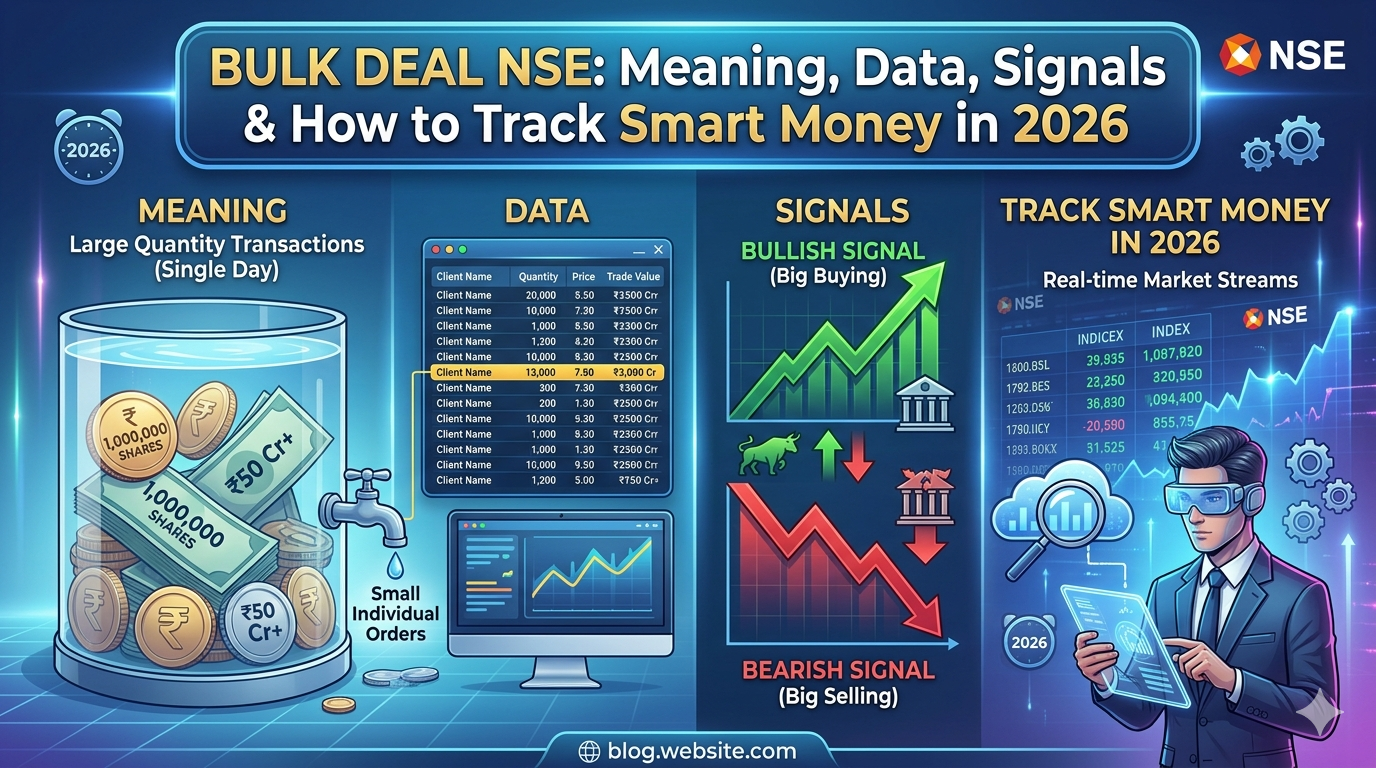
A bulk deal is a large stock transaction that happens on a stock exchange (like National Stock Exchange or Bombay Stock Exchange) when an investor buys or sells a significant number of shares in a single trade.
📊 Simple Definition
A bulk deal occurs when:
👉 An investor buys or sells 0.5% or more of a company’s total shares
👉 And the transaction happens in a single trading session
🔍 Key Features
- Executed during normal market hours (not pre-arranged like block deals)
- Can be done through multiple trades but within the same day
- Must be reported publicly by the exchange
💰 Example
If a mutual fund buys 10 lakh shares of a company in one day, and that equals more than 0.5% of the company’s total shares → it is a bulk deal.
⚖️ Bulk Deal vs Block Deal
| Feature | Bulk Deal | Block Deal |
|---|---|---|
| Timing | Throughout the day | Fixed window (usually morning) |
| Size | ≥ 0.5% of equity | Large quantity (no fixed %) |
| Execution | Market-driven | Pre-arranged between parties |
📈 Why It Matters
- Signals “smart money” activity (FIIs, mutual funds, institutions)
- Can indicate bullish or bearish sentiment
- Traders often track bulk deals for short-term opportunities
How to track on National Stock Exchange
Go to the official NSE site — it’s the most reliable source.
Institutions (like mutual funds, FIIs, insurance companies) use bulk deals mainly for efficiency, strategy, and minimal market disruption. Here’s the real logic behind it:
Why institutions use bulk deals
1. Build or Exit Large Positions Quickly
If an institution wants to buy or sell lakhs (or crores) of shares, doing it in small chunks can take days and move the price against them.
A bulk deal allows them to:
- Enter a stock fast
- Exit without dragging the price down too much
2. Reduce Market Impact
Imagine a fund trying to buy 50 lakh shares in the open market—price will spike immediately.
Bulk deals help:
- Execute trades at a pre-agreed price
- Avoid sudden volatility
- Keep the trade discreet (to some extent)
3. Strategic Investing (Smart Money Moves)
Institutions often use bulk deals when they have:
- High conviction in a stock
- Insider-level research (not illegal insider trading, but deep analysis)
- Long-term allocation plans
That’s why bulk deals are often tracked as “smart money signals.”
4. Portfolio Rebalancing
Funds constantly adjust portfolios based on:
- Sector allocation
- Risk management
- Benchmark changes
Bulk deals help them quickly:
- Shift capital from one stock to another
- Maintain target weightages
5. Better Price Negotiation
Unlike retail investors, institutions can:
- Negotiate directly with another large seller/buyer
- Lock in a fixed price
- Avoid slippage
6. Regulatory Simplicity (Compared to Block Deals)
On exchanges like National Stock Exchange of India and BSE Limited:
- Bulk Deal: Happens during normal trading hours, disclosed if >0.5% equity
- Block Deal: Happens in a special window with stricter conditions
Bulk deals are often easier to execute operationally.
7. Signaling & Liquidity Opportunities
Sometimes institutions intentionally take bulk positions because:
- It attracts attention from retail investors
- Improves liquidity in that stock
- Helps future entry/exit
Bottom Line
Bulk deals are not random—they are planned, strategic, and capital-efficient moves by institutions to handle large volumes without hurting their own trade.
How to interpret signals
Interpreting bulk deal signals is where most people go wrong—they see “big money buying” and jump in blindly. That’s a fast way to lose money.
Here’s how to read them like smart money instead of reacting like retail:
1. Don’t Judge by One Day — Look for Consistency
A single bulk deal means almost nothing.
What matters:
- Repeated buying over multiple days
- Same institution accumulating
👉 If a fund keeps buying, it signals conviction, not just a one-off trade.
2. Check Who is Buying or Selling
Not all institutions are equal.
High-signal buyers:
- Mutual funds
- Insurance companies
- Long-only FIIs
Lower-signal / mixed intent:
- Prop desks
- Unknown entities
👉 If a reputed fund is buying, it’s usually research-backed. If random names appear, be cautious.
3. Delivery Volume is the Real Confirmation
Bulk deal + low delivery = weak signal
Bulk deal + high delivery = strong signal
Why?
- High delivery means shares are actually being held, not just traded intraday
👉 This is one of the most powerful confirmations.
4. Price Action Matters More Than the Deal
Even if institutions are buying:
- If price is falling → they may be early or wrong
- If price is stable → accumulation phase
- If price is rising with volume → strong bullish signal
👉 Always combine bulk deals with price + volume behavior
5. Look at the % of Equity Bought
- Near 0.5% → minimum disclosure, not very strong
- 1–2% → meaningful position
- 3–5%+ → high conviction
👉 Bigger stake = stronger intent
6. Spot Entry vs Exit Signals
Bullish signal:
- Bulk buying near support
- After a correction
- With rising delivery
Bearish signal:
- Bulk selling after a rally
- Near resistance
- With heavy volumes
7. Context is Everything
Same bulk deal can mean different things depending on context:
| Situation | Meaning |
|---|---|
| After big fall | Accumulation |
| At all-time high | Profit booking |
| Sideways market | Position building |
8. Avoid the Biggest Retail Mistake
❌ “Institution bought → I should buy immediately”
Reality:
- Institutions buy in phases
- You often see the first layer, not the full position
- Price may consolidate or even fall after the deal
👉 Best approach:
Wait for confirmation (price breakout + volume)
Simple Framework (Use This Every Time)
Before acting on any bulk deal, check:
- Who bought?
- How much % stake?
- Delivery high or not?
- Price trend?
- Repeat buying happening?
If 3–4 of these align → strong signal
If not → ignore
Bottom Line
Bulk deals are clues, not conclusions.
They tell you where smart money is looking, not when you should act.